Key takeaways
- AI safety monitoring uses computer vision to identify predefined hazards and safety conditions from visual data.
- Industrial computer vision can monitor PPE compliance, restricted areas, unsafe conditions, and other visible risks.
- Effective AI safety monitoring connects detection with alerts, human intervention, evidence, and corrective action.
- AI works alongside hazard assessments, engineering controls, procedures, and human judgment.
- Telepresenz SmartEYE™ connects computer vision, real-time alerts, incident management, and safety visibility for industrial operations.
Industrial safety teams may need to monitor environments where conditions can change within seconds.
Between scheduled inspections, workers may enter restricted areas or miss PPE requirements, and equipment may end up in the wrong place. Human supervisors remain essential, but continuous observation across multiple locations is difficult to achieve manually.
The scale of the problem shows up in occupational fatality data. The U.S. Bureau of Labor Statistics recorded 5,070 fatal work injuries in 2024. In the private mining, quarrying, and oil and gas extraction sector, there were 92 fatal work injuries, 65 of them in the oil and gas extraction industry. The sector’s fatal injury rate was 13.8 per 100,000 full-time equivalent workers. The overall U.S. rate was 3.3.
AI cannot eliminate workplace incidents. Even so, these numbers show why industrial organizations keep looking for ways to spot visible safety risks earlier and respond faster and more consistently.
This is where AI safety monitoring and computer vision can play a role.
What is AI safety monitoring?
AI safety monitoring uses artificial intelligence to continuously analyze visual, sensor, or operational data, identify predefined safety risks, and alert the responsible team for review or action. In industrial operations, it adds a layer of visibility between scheduled inspections.
For visual safety monitoring, computer vision is especially relevant. It lets AI systems process images or video and recognize patterns or objects that were defined during system development.
Traditional monitoring depends on people being in the right place at the right time. AI safety monitoring checks defined conditions all day and flags them for people to review. It can also combine camera video with sensor and operational data.
In practical terms, an industrial AI safety monitoring system can follow a sequence like this:
Visual data → AI analysis → Risk detection → Alert → Human response → Documentation → Corrective action
A camera in a facility with AI told to “watch workers” is only the starting point. The operational value comes from what happens after a potential risk is detected.
AI safety monitoring vs. computer vision
The two terms often get used as if they mean the same thing, but computer vision is one technology inside the larger system that AI safety monitoring describes.
| Computer vision | AI safety monitoring |
|---|---|
| Interprets visual information. | Uses AI to monitor safety conditions. |
| Mainly camera- and video-based. | Can combine visual data with other operational data. |
| Detects objects, behaviors, and conditions. | Turns detected conditions into safety events and alerts. |
| A technology capability. | A broader safety monitoring application. |
How does computer vision detect industrial safety risks?
Computer vision systems analyze visual information and compare what they see against patterns, objects, behaviors, or conditions they have been designed to recognize.
Depending on the system and deployment environment, this can include:
PPE compliance
AI can identify whether required protective equipment is present, like helmets, safety vests, gloves, or other specified PPE.
Restricted-zone access
Computer vision can identify when a person enters an area where access is restricted or where extra controls are required.
Unsafe conditions
Visual systems can be configured to identify defined environmental or operational conditions, like obstructions, spills, smoke, fire, or other visible hazards.
Unsafe acts or behavior
AI can identify predefined behaviors or activity patterns linked to safety procedures.
Worker positioning and movement
Computer vision can monitor worker behavior, positioning, and activity when these are tied to a defined safety risk.
A 2024 Gartner research note lists hazard identification, compliance monitoring, PPE detection, behavior recognition, and safety monitoring as emerging computer vision use cases for worker safety. Gartner expects predictive and prescriptive analytics to enhance these capabilities over time for accident prevention.
One qualification applies to all of these: AI detection is only as useful as the risk it has been trained and configured to recognize.
From detection to prevention: The missing link in AI safety monitoring
One of the biggest differences between basic computer vision and operational AI safety monitoring is what happens after detection.
A system that identifies a worker without a helmet has detected a condition.
A safety system that identifies the condition, alerts the responsible person, records the event, and supports corrective action has created an operational response loop.
A useful industrial safety workflow looks like this:
Detect
The computer vision system identifies a predefined safety condition.
Verify
The system checks the visual event against the detection rules and the information available.
Alert
The right supervisor, HSE professional, or safety team receives an alert.
Respond
A responsible person investigates the condition and takes the right corrective action.
Document
The event, evidence, response, and resolution can be recorded for later review.
Analyze
Safety teams can spot repeat patterns and use them to improve procedures and controls.
This is where AI moves from surveillance toward safety intelligence.
What can AI safety monitoring detect?
The exact capabilities depend on the computer vision model, camera setup, environmental conditions, and the organization’s specific use case.
Common industrial applications include:
| Safety use case | What AI can monitor |
|---|---|
| PPE compliance | Required protective equipment, such as helmets, safety vests, and other specified PPE. |
| Restricted areas | Unauthorized entry or breaches of designated safety zones. |
| Hazard detection | Defined visible hazards, including obstructions, spills, and other unsafe conditions. |
| Fire and smoke | Visual indicators of fire or smoke. |
| Unsafe behaviour | Predefined unsafe actions or behaviours linked to safety procedures. |
| Worker positioning | Worker location and movement within defined areas. |
| Ergonomics | Posture and movement patterns, where supported by the system. |
| Site monitoring | Visual safety conditions across multiple work areas or locations. |
By risk category:
- Visual compliance: PPE, safety equipment, and restricted-area access.
- People and behavior: Unsafe behaviors, worker proximity to hazards, and unsafe positioning.
- Equipment and interaction: Vehicle and pedestrian proximity, machinery zones, and unsafe equipment interactions.
- Environmental conditions: Smoke, fire, spills, blocked areas, and other visible hazards.
- Site activity: Crowding, access violations, and work-zone conditions.
The technology is therefore broader than PPE detection.
NIST identifies AI-enabled cameras and computer vision as a manufacturing use case for real-time safety monitoring, including detecting safety hazards and compliance issues across production floors. This shows how visual AI can move safety monitoring from periodic observation toward continuous analysis of operating environments.
For industrial organizations, detection alone is not enough. The value of AI safety monitoring depends on whether identified conditions turn into timely, actionable responses. A system that produces too many irrelevant alerts can overwhelm safety teams, and missed detections can leave important risks unaddressed.
AI safety monitoring does not replace traditional safety controls
AI should not be positioned as a replacement for established safety practices.
OSHA’s hierarchy of controls ranks safeguards from most to least effective as elimination, substitution, engineering controls, administrative controls, and PPE. OSHA also notes that organizations may need to combine control methods to protect workers adequately.
That makes computer vision an added layer of safety intelligence that sits next to:
- Hazard assessments
- Engineering controls
- Safe work procedures
- Training
- Administrative controls
- PPE
- Human supervision
- Emergency procedures
Say an AI system detects a worker entering a hazardous zone. The organization still needs the underlying safety procedure, physical controls, responsible personnel, and a corrective-action process.
AI can help identify and surface the condition faster.
Where AI safety monitoring adds the most value
AI safety monitoring adds the most value where people cannot watch every area at once, like the time between scheduled inspections and across multiple sites.
Continuous visibility
Defined conditions are checked all day, between inspections.
Faster awareness
The responsible person learns about a visible risk sooner.
Consistent monitoring
The same rules apply across shifts, crews, and sites.
Better evidence
Events and responses are recorded for review.
Multi-site visibility
Safety teams can see conditions across locations from one place.
The role of human oversight in AI safety
Safety-critical AI also requires human oversight.
Organizations deploying AI in workplaces need to think about transparency, privacy, accountability, bias, and the ability of workers and safety professionals to understand how AI systems operate.
A simple principle applies here: AI should support safety decisions and leave accountability with people.
A safety manager should know:
- What the system detected
- Why an alert was generated
- What evidence supports the alert
- Who received the alert
- What action was taken
- Whether the condition was resolved
This gives a more defensible operational model than treating AI as an autonomous safety authority.
Why real-time monitoring matters
Traditional inspections are valuable. They happen at set times.
A worker may be compliant when an inspection occurs and exposed to a different risk several hours later.
Continuous or near-real-time monitoring changes the timing of detection.
Instead of:
Risk → Incident → Investigation
The goal becomes:
Risk → Detection → Alert → Intervention
This matters most where multiple crews, contractors, assets, and activities operate at the same time.
A 2025 study by McKinsey and MIT’s Machine Intelligence for Manufacturing and Operations program found emerging evidence that leading companies are starting to generate value from AI in operations. Across more than 100 companies, AI leaders showed a 3.8x performance gap over the rest. The research pointed to executive sponsorship, a maturing partner ecosystem, cross-departmental collaboration, and investment in data as the factors that set leaders apart.
The lesson for industrial safety is straightforward: AI technology works best when it is built into the operating process.
What makes an industrial AI safety monitoring system effective?
Organizations evaluating AI safety monitoring should look beyond the AI model itself.
Detection accuracy
The system needs to identify the conditions that matter to the organization.
Relevant alerts
Safety teams need useful alerts, and a flood of notifications gets in the way.
Existing infrastructure
Check whether the system can work with existing cameras and visual infrastructure, which avoids a new hardware environment.
Evidence and documentation
Safety events should create usable records that support investigation, reporting, and continuous improvement.
Human oversight
Safety professionals should stay responsible for interpreting and acting on safety events.
Scalability
The system should support monitoring across multiple locations and go beyond a single-site experiment.
Data governance
Organizations need clear policies on video retention, privacy, access, and data usage.
Integration with operations
The strongest systems connect detection with the workflows safety and operations teams already use.
How Telepresenz uses AI for industrial safety monitoring
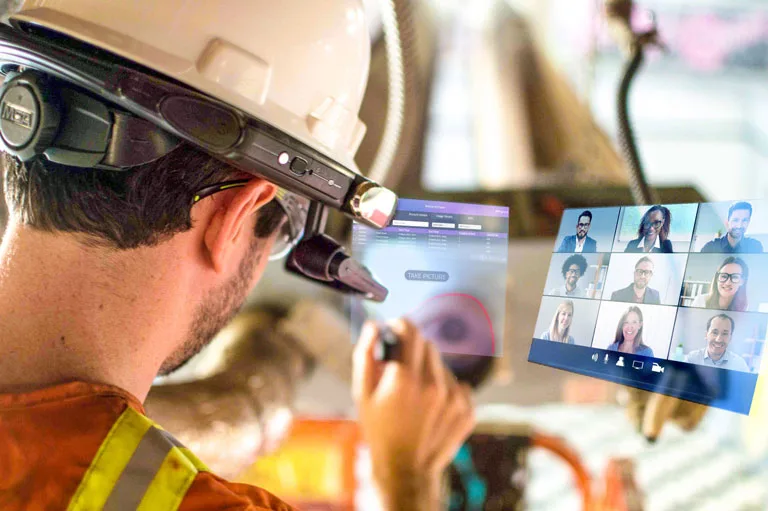
Telepresenz uses SmartEYE™, its AI-powered computer vision safety platform, to monitor industrial environments in real time and help safety teams identify risks, monitor compliance, and respond to critical events faster.
SmartEYE™ can work with visual inputs from CCTV, IP cameras, bodycams, drones, and phone cameras. Its computer vision capabilities include PPE detection, identification of unsafe conditions and hazards, restricted-zone monitoring, and real-time safety alerts.
SmartEYE™ connects real-time visual monitoring with alerts, centralized oversight, and incident management, helping safety teams move from detection to response and documentation. Its incident-management capabilities include automated incident documentation, workflow management, root-cause analysis, and corrective-action tracking.
In practice, the operational flow can be understood as:
Visual monitoring → AI detection → Safety alert → Human response → Incident documentation → Corrective-action tracking
SmartEYE™ is designed for industrial environments where teams need greater visibility into safety conditions across sites. Its applications span oil and gas, energy and utilities, manufacturing, transportation, and other high-risk industrial operations.
This connects AI-powered visual intelligence with the broader safety workflow.
The future of AI safety monitoring is operational, not just visual
The next stage of industrial AI safety may combine computer vision with sensors, operational systems, and predictive analytics. Whatever the technology, the value depends on what happens after the system recognizes a risk.
The next question is what happens after the system recognizes the risk.
A mature AI safety monitoring environment should connect:
Detection
Identify a predefined safety condition.
Verification
Review the event against the available information and detection rules.
Alert
Notify the appropriate person or team.
Human intervention
Assess the situation and decide on the appropriate response.
Evidence
Record the event and relevant supporting information.
Corrective action
Address the confirmed safety issue and track its resolution.
Analysis and improvement
Use recorded events to identify recurring issues and improve safety processes.
That is the difference between AI-powered monitoring and AI-enabled safety operations.
AI can add another layer of visibility into environments that are hard to monitor continuously. Its value depends on the quality of the underlying safety program, the reliability of the technology, the relevance of the alerts, and the organization’s ability to act on what the system identifies.
For industrial companies, the opportunity is to give safety professionals more timely information, broader visibility, and better evidence to make safety decisions.
See SmartEYE™ in Action
Turn AI-powered safety monitoring into real-time visibility across your industrial operations.
FAQs
It may. Whether existing cameras work depends on camera position, resolution, field of view, lighting, camera angle, network connectivity, the detection needed, and the processing setup. SmartEYE™ supports visual inputs from CCTV, IP cameras, bodycams, drones, and phone cameras.
AI safety monitoring can detect defined safety conditions such as PPE violations, unsafe acts, restricted-zone access, fire and smoke, and other visible hazards. The exact detections depend on the AI models, camera setup, and environment.
When a predefined safety condition is detected, the system can generate an alert for the relevant safety or operations team. This connects automated detection with human review and corrective action.
SmartEYE™ supports visual inputs from CCTV, IP cameras, bodycams, drones, and phone cameras. It uses AI-powered computer vision to monitor industrial environments, detect safety risks, and generate real-time alerts.
Telepresenz SmartEYE™ provides centralized AI-powered safety monitoring across multiple industrial sites. It helps safety teams monitor safety conditions, receive alerts, and review safety events across distributed operations.
Written by

Indu Tolia
Founder and CEO of Telepresenz
She leads the company’s work to help industrial organizations make frontline work safer, more connected, and more efficient through technology.
Connect with Indu Tolia on LinkedIn

